
AI video analysis uses multimodal models to read the visuals, speech, on-screen text, and sound in a clip, then turns them into data you can search and count. A general model is enough to summarize one video. A purpose-built platform earns its place when you need consistent reads across thousands of social videos, each traceable to its source clip.
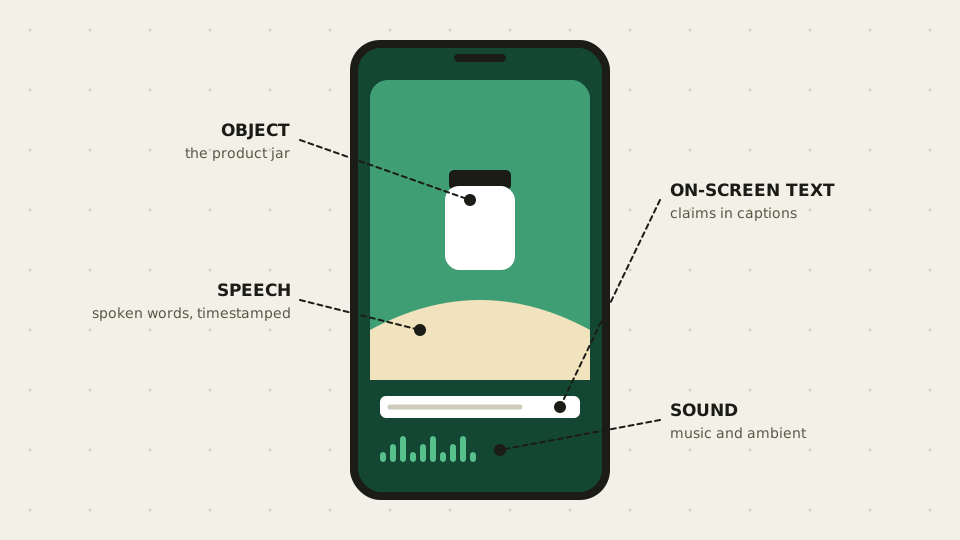
- AI video analysis reads four layers of a clip: what is seen, what is said, what is written on screen, and what is heard.
- Limits are real. Google's Gemini docs say the default sampling rate is 1 frame per second, so rapid motion can be missed.
- Three approaches to AI video analysis exist, from general multimodal models and video APIs to purpose-built social video platforms.
- Pick by volume and by whether every finding traces back to the clip it came from.
- Google has deprecated its Video Intelligence API, so check any vendor's support horizon before you build on it.
Most consumer opinion about your category is now filmed and posted as video. In Pew Research Center's 2026 survey, 84% of U.S. adults said they ever use YouTube and 51% said Instagram (Pew Research Center). Among adults 18 to 29, the figures were 95% for YouTube and 79% for Instagram, with 65% for TikTok.
That audience does not fill in surveys. It shows a product on a bathroom shelf and says what it thinks out loud. Then a hundred strangers reply. AI video analysis is how a brand team reads that material without watching every clip.
This guide covers what AI video analysis can and cannot read, and when each of the three approaches is enough. The phrase "video analytics" also covers security and sports uses, which are outside this guide.
What is AI video analysis?
AI video analysis is the use of machine learning models, usually multimodal ones, to watch a video and convert it into structured information about what appears on screen, what is said, what text is shown, and what is heard, with timestamps so you can find each finding in the clip again.
What is a multimodal model? A multimodal model takes more than one kind of input, such as images and audio, in a single request and reasons across them.
Google's documentation describes Gemini's video abilities as describing, segmenting, and extracting information from videos, answering questions about their content, and referring to specific moments by timestamp (Google AI for Developers). That is the general-purpose end of AI video analysis. Other tools return labeled detections or searchable moments instead of free-text answers.
You will see the same idea under other names, such as an AI video analyzer or video content analysis. They mostly describe one job: a tool takes a clip in and gives back a structured account of what the clip contains. What differs is the scale and how you check the answers.
What can AI video analysis read from a social video?
AI video analysis can currently read objects and packaging, how a product is used, spoken words, text laid over the frame, and music or other sound, but each comes from a different layer of the model and vendors document them separately, so test each one on your own clips first.
Objects and packaging. Google's Video Intelligence API lists object tracking and logo recognition as separate features (Google Cloud). Its logo page says the API can recognize over 100,000 brands and logos in video (Google Cloud). Twelve Labs groups objects, actions, events, and brand logos under its visual modality (Twelve Labs).
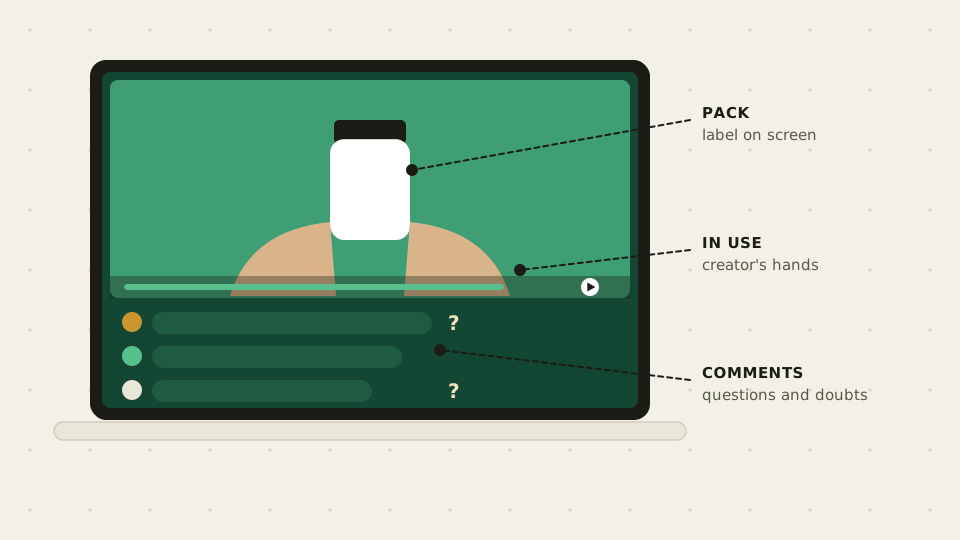
How a product is used. Usage shows up as actions and events, such as a cap twisted off or a scoop levelled. Twelve Labs lists actions and events as part of what its visual modality covers. In the Convosight influencer case study covered below, the checks included product visibility and pack legibility, plus whether the video demonstrated the benefit and the application.
Speech. Twelve Labs defines transcription as spoken words extracted from the audio track. Google Cloud lists speech transcription as its own feature. Gemini processes the audio and visual streams of a video together, according to its docs.
Text on screen. Google describes its text detection as optical character recognition that detects and extracts text within a video (Google Cloud). It returns each string with start and end times and a bounding box per frame. Creators put claims and ingredient names in captions, so this layer often carries the message.
Sound. Twelve Labs defines audio as ambient sound and music, along with sound effects. In its Models product, audio covers non-speech sound only, and speech needs the transcription modality. That split is a reminder to check how a tool handles a clip where the music and the voice-over say different things.
What can AI video analysis not read?
AI video analysis reads what is visible and audible in the frames it samples and very little else, so it struggles with fast cuts and with meaning that depends on context outside the clip or on tone and culture, which is why every output needs a check against the source video.
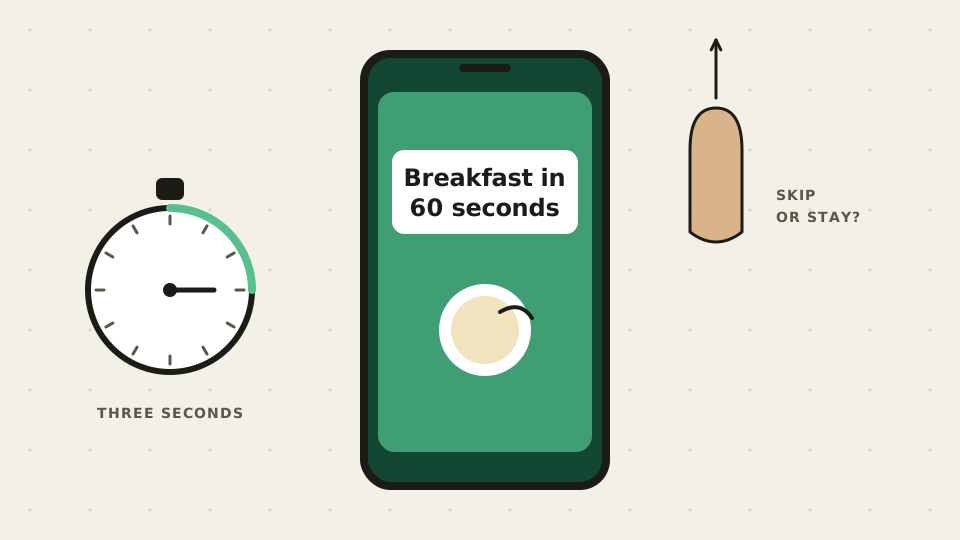
The sampling limit is documented. Gemini's video guide says visual descriptions are sampled at 1 frame per second by default, and that this "may miss details in videos with rapid motion or quick scene changes" (Google AI for Developers). A fast product reveal or a quick label flash can fall between two samples. The docs add that the default works well for most content.
Access has limits too. Gemini's YouTube URL feature accepts public videos only, not private or unlisted ones, and it is in preview, with pricing and rate limits that may change. Nothing in that documentation tells you how to pull a clip's comments or its view counts, so those are separate inputs you would gather yourself.
Meaning is the harder gap. A model can tell you a creator held up a serum and praised it. It cannot tell you whether she was paid or whether her audience believed her. Intent and irony are where a human reviewer still earns the time, and where the comments often settle the question.
How does video sentiment analysis work on social platforms?
Video sentiment analysis scores the emotion in a clip and in the reaction to it, and because the clip is only half the signal on social platforms, a useful read takes in the video together with the comments and the creator's own framing around it.
Sentiment is one output of AI video analysis, and it is only as good as the context it reads. Raw social media video analytics, such as views and likes, tells you how far a clip traveled. It does not tell you what was in it or why people responded. Content-level AI video analysis fills that gap by labeling what was shown and said, then lining it up against the response.
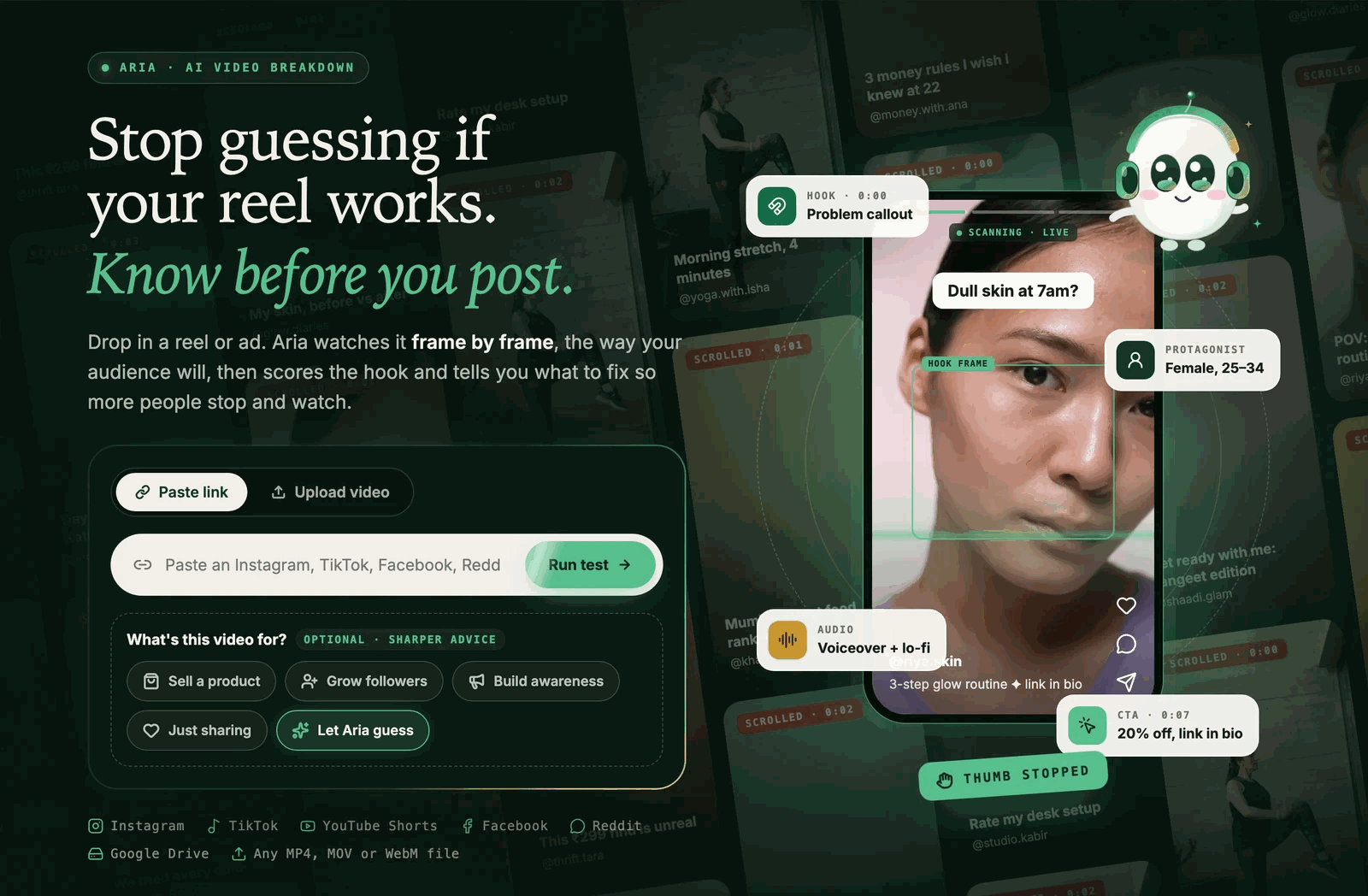
Convosight describes its approach as reading four things at once: what people said, what they showed, what they felt, and what went unsaid. Its site says Video Intelligence reads video plus comments across Instagram, TikTok, YouTube, Reddit, Facebook, X, and more. That pairing is the design choice worth copying, whatever tool you use. A clip that looks cheerful above a comment section full of doubt is a different finding from one with a warm thread beneath it.
Which AI can analyze video, and which approach fits?
Which AI can analyze video depends on the job, because the approaches differ less in what they can see than in what surrounds the model: general models and video APIs work on clips you supply, while social video platforms collect and compare thousands of clips for you.
General multimodal models. These are the fastest way to start with AI video analysis. Gemini accepts files through its File API, up to 20GB on the paid tier, and public YouTube URLs (Google AI for Developers). Models with a 1M context window can process videos up to 3 hours long at low media resolution, and Gemini 2.5 and later accept up to 10 videos per request.
You write the question and collect the videos yourself. You also store the answers somewhere.
Video APIs. These return structured detections rather than prose. Google Cloud's Video Intelligence API offers nine features, among them shot change detection and face detection. Twelve Labs describes its models as searching, analyzing, segmenting, and creating embeddings, and says it finds exact moments in videos (Twelve Labs).
Google's own page carries a warning. The Video Intelligence API is deprecated as of September 14, 2026, and will shut down on September 14, 2027 (Google Cloud). Google recommends moving to Gemini, so anyone who built a pipeline on the API now has a migration to plan.
Purpose-built social video platforms. These wrap the model in what a research team needs: collection from social channels, plus comments, filters, and reporting. Convosight's site says it has watched and analyzed 500M+ videos and 2B+ conversations (Convosight's own figures). It also says it reads 120+ languages across 9+ channels, and names its reading layers as Product, Routine, Emotion, Intent, Setting, and Audience signal.
When is a general model enough, and when do you need a platform?
If you only need to summarize one video or a handful, a general multimodal model is enough and costs little, but a platform matters when you need the same questions answered across thousands of videos, with the same definitions every time and every finding traceable to its source clip.
Take a brief you can finish in an afternoon: what does a competitor's launch film say about its new flavor? Paste the clip into a general model, ask for the claims and the visuals, and you are done. A platform would be extra weight for that job. The same logic applies to any tool, including Convosight.
The picture changes with volume. Four needs tend to push AI video analysis past a general model:
- Scale: one request handles up to 10 videos in Gemini, while a category read may need thousands.
- Consistency: the same definition of "product shown" must apply to the first clip and the ten-thousandth.
- Traceability: every theme should open onto the exact clips behind it, so a skeptical stakeholder can watch them.
- Coverage: the same question should run across platforms and languages, with comments read alongside the video.
Traceability is the one teams underrate. Convosight's site says its answers are re-verified claim by claim, with receipts attached. A summary nobody can check will not survive a business review.
How do brands use AI video analysis?
Brands use AI video analysis in two main ways: insights and R&D teams read video for unmet needs and category shifts, while brand marketing teams use it to track campaigns and to vet creators, and both depend on reading many clips the same way every time.
For insights work, the question is usually about the consumer rather than the clip. Which routines are forming, and which claims do people repeat in their own words? Video helps because people demonstrate habits that they would never think to mention in a survey. If that is your use, the guides on white space analysis and consumer insights show how those reads turn into decisions.
For marketing work, the clip itself is the object. A Convosight influencer content quality-control case study describes a skincare brand scaling its influencer program from about 100 to over 1,000 influencers a month across several agency partners. The page says the engine checked audio, visuals, on-screen text, and brand safety across more than 28 quality parameters, then sorted each video into go, review, or reshoot. It reports more than 3,000 videos a month and a turnaround of 2 hours for 100 videos.
Social listening is another place this lands. Teams that already track conversations on TikTok add the video layer to see what the posts show as well as what they say. The Convosight guide to TikTok social listening covers that side in more detail.
How should you evaluate an AI video analyzer?
Judge an AI video analyzer on four questions: whether you can open the clip behind each finding, whether it reads comments with the video, whether it applies the same definitions across the whole batch, and whether it covers your platforms and languages.
A strong demo of AI video analysis on one clip proves very little about the thousandth. Run a pilot on a set you have already watched. Pick 50 clips where you know the right answer and compare the tool's labels against yours. Where it misses, note whether the cause was sampling or missing context, because each has a different fix.
Ask about the product's life as well. Google's own deprecation notice is a fair reminder that a video API can be retired on a schedule you do not control. Ask any vendor how long a given model or endpoint will be supported and what the migration path looks like.
Where to go next
To see how Convosight does AI video analysis on social video from TikTok, Instagram, YouTube, and other channels, with comments, for CPG insights and brand marketing teams, Book a demo. Convosight is trusted by Unilever, Abbott, Kenvue, Pepsi, SC Johnson, and Kimberly-Clark.
FAQ
What is AI video analysis?
AI video analysis uses machine learning models to watch a video and return structured information about it, such as the objects shown, the words spoken, the text on screen, and the sounds heard. Each finding is usually tied to a timestamp, so you can return to the exact moment in the clip.
Which AI can analyze video?
General multimodal models such as Google's Gemini accept video and answer questions about it, and video APIs like Twelve Labs return searchable moments. Purpose-built platforms, including Convosight, read social video at scale. Which one fits depends on how many videos you have and whether you need comments and traceability.
What is an AI video analyzer?
An AI video analyzer is a tool that takes a video in and gives back a description of its content. Some are simple upload tools that summarize a single clip. Others are platforms that collect many videos from social channels and group the results into themes.
Can AI analyze TikTok and YouTube videos?
For YouTube, Gemini's documentation says you can pass public YouTube URLs directly, in preview, but not private or unlisted videos. TikTok handling depends on the tool, and the documentation reviewed for this guide does not describe it. Convosight's site says it reads social video from TikTok and YouTube, with comments.
Is AI video analysis accurate?
It depends on the clip and the task. Vendor documentation names specific limits. Gemini samples at 1 frame per second by default and may miss details in rapid motion or quick scene changes. Test any tool on clips you have already watched and compare its labels with yours before you trust it at scale.
How is video content analysis different from video analytics?
Video content analysis looks at what is in a video: its objects, speech, text, and sound. Video analytics is a wider term that also covers counting and monitoring uses such as security and sports. For brands, the content-level meaning is what matters, and it is the focus of this guide.