
Consumer insights explain why shoppers behave the way they do, in a form a team can act on. CPG teams build them from surveys and sales data, and now from social video too. Judge any insight by one test: does it change a decision about what to build, what to say, or who to say it?
- A consumer insight is the reason behind a pattern, not the pattern itself. Data and findings come first, and the insight comes last.
- Real insights behind known brands name a tension that people feel. They do not just describe a demographic.
- Every method has a blind spot. Surveys over-report good intentions, and sales data cannot say why.
- Social video shows what people do and say in public. It belongs beside surveys and sales data, not in place of them.
Consumer insights are the most useful and the most abused phrase in a CPG research deck. Teams call a chart an insight, then wonder why nobody acts on it. This guide defines the term in plain words, separates data from findings from insights, and walks through real examples. It then compares the main methods honestly and shows how insights turn into decisions on new products and on claims, as well as creator work.
What are consumer insights?
Consumer insights are explanations of why people buy, use, or skip a product, written clearly enough that a team can act on them. They interpret data rather than repeat it. Greenbook defines them as the interpretation of research and other data to explain customer behavior and guide business decisions.
In CPG the reader of that explanation is specific. A brand manager has to pick a claim, and an R&D lead has to choose a flavor to prototype. Each of them needs a reason, not a table.
Consumer insights are often confused with market research, and the two are related. Greenbook describes market research as collecting and analyzing data to answer discrete business questions, while insights work goes on to answer why and not just what. Research is an input. The insight is what you write after you have read the inputs and thought hard about them.
How do data, a finding, and an insight differ?
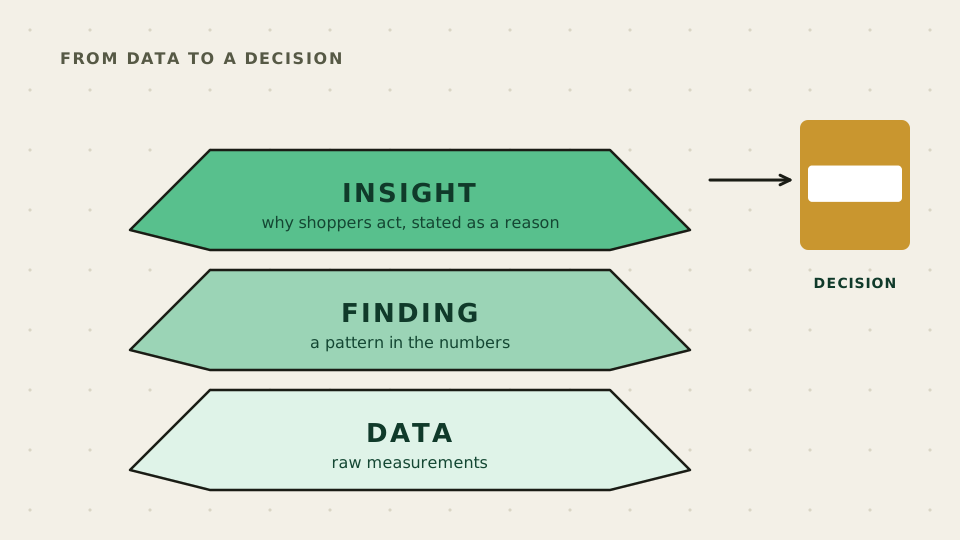
Data is a raw measurement. A finding is a pattern in that data. An insight is the reason behind the pattern, stated so that it points to an action. Most decks stop at the finding, which is why they feel true and still change nothing.
What is a consumer insight? A consumer insight is a non-obvious, evidence-backed reason behind a behavior that suggests what a brand should do next.
Here is a real set of numbers to show the three layers. A Convosight case study on protein in India looked at six months of public conversation, from July 2024 to June 2025, across Instagram, YouTube, Facebook Groups, Google search, and Amazon reviews. It covered 2,636 top posts and 84K community conversations. On sentiment, the case study reports 53% positive, 36% confusion, and 11% negative.
Those percentages are the data. The finding is that confusion is more than three times as common as outright negativity. The page says the confusion is about when, how, and how much protein to consume.
The insight is our reading, not a client conclusion. People appear to want protein in their daily food but do not know how to fit it into a day, so the barrier is usage guidance and not belief. The case study reports no sales or campaign results, so treat this as a starting hypothesis.
Now see how that hypothesis turns into a decision. Illustration, not a client result: a brand with a protein snack could test pack-side serving ideas against its current pack, because the problem looks like "how do I use this" and not "is this good for me." A claim about benefits would miss the point. That is what an insight does that a finding cannot.
What are examples of consumer insights behind real products and campaigns?
The best-known consumer insights examples start from a tension people already feel but rarely say aloud. Dove and Always both built long campaigns on one. Each began with something a survey or a conversation revealed, and each turned it into a position that no competitor had claimed.
Take Dove. Its real beauty work began in 2004 with a finding that only 2% of women globally considered themselves beautiful, according to Dove's own 20-year release. That page does not describe the research method, so read the number as the brand's account.
The finding is the 2%. The insight, as we read it, is that the category's ideal felt out of reach for almost everyone. That left room for a brand that did not ask women to measure up.
Always followed a similar path. The brand's Cannes entry on WARC states the insight plainly: many girls lose their confidence once they hit puberty. It adds that Always had supported girls through puberty with education for 30 years, yet people did not know, because the brand was not talking about it.
The idea was the #LikeAGirl social experiment, which set out to reverse the playground meaning of the phrase. The entry reports 48 million views in North America and 76 million globally. It is an award submission, so the results are self-reported.
Two things stand out in both cases. The insight named a feeling, not a segment. And it pointed at a role for the brand, not just a media plan.
How do you find consumer insights?
You find consumer insights by starting with one business decision, pulling from at least two sources that can disagree, and then explaining the gap between them. No single method is enough. Surveys show what people claim, sales data shows what they bought, interviews expose motives, and social video shows public behavior.
The process is short, and the discipline is in the order:
- Write the decision first. "Which of two claims goes on the next pack?" is a decision. "Learn about Gen Z" is not.
- Collect from two or more sources that see different things.
- Look for tension, such as people saying one thing and doing another.
- Write the insight as one sentence that starts with a person and ends with an action.
- Test it cheaply before you build on it.
Gathering consumer insights is the easy half. Most CPG teams already hold more data than they can read. The hard half is the sentence in step four.
Surveys and trackers
Surveys are good at sizing. They tell you how many people hold a view, across groups you can define, and they let you track change over time. They are weak on motive and on behavior. The say-do gap, which Quirks defines as the difference between what people say they will do and what they actually do, shows up most when respondents report on themselves.
Retail and sales data
Scan and shipment data is the ground truth on what sold, where, and at what price. It cannot tell you why. A flat quarter might come from a weak flavor or a competitor deal, and the numbers look the same in both cases.
Interviews and ethnography
Depth interviews and in-home visits are the best tool for motive. A good researcher hears the reason behind the reason. The costs are small samples and slow turnaround, and an interview setting can push people to give tidy answers.
Reviews and service logs
Product reviews and customer service logs capture unprompted complaints from people who bought. That makes them honest on product problems. They skew toward people with strong feelings, and they say little about people who never bought.
Social video and comments
Short video shows people using products, describing routines, and arguing in the comments, all without a researcher in the room. It is quick, it is unprompted, and it surfaces the words people really use. It also has limits, covered below.
How do consumer insights turn into decisions?
Consumer insights become decisions when each one is tied to a named choice and a named owner before the work starts. In CPG, the same few choices come up again and again: what to build next, what to say on the pack and in the ad, who should carry the message, and when to launch. The same insight can feed all three.
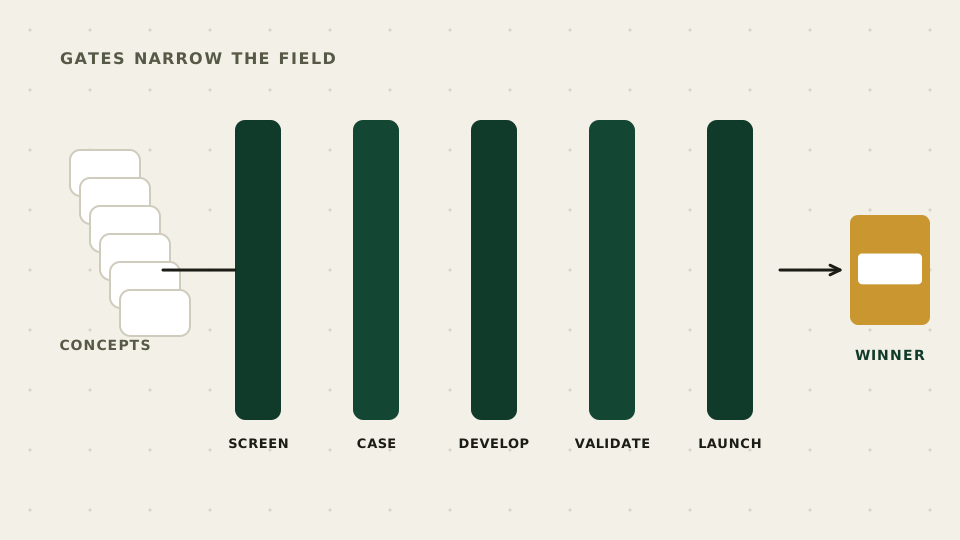
For new products, insights narrow the field. A team that sees the same unmet need across several sources can map where demand has no good answer yet, which is the logic of white space analysis. It can then put concepts in front of consumers before spending on tooling, as laid out in this guide to product concept testing.
For claims, the value is in language. If shoppers say "easy to fit in" and the pack says "high in protein," the pack is answering a question nobody asked. The protein example above is a case of this: the confusion theme suggests testing usage-led copy against benefit-led copy.
For creator and campaign work, insights set the brief. They tell you which routine the content should sit inside, which format earns attention, and which objections the comments will raise. A creator who already makes content in that routine is a better pick than one with a bigger audience and no connection to it.
The Convosight protein page describes its output as a roadmap for consumer-first messaging, product format ideas, and cultural relevance. It reports no measured business results, and any honest summary of insight work should say the same. An insight is a better bet, not a guarantee.
Where does social video add a signal, and where does it fall short?
Social video adds a fast, unprompted view of how people talk about and use products, which surveys and sales data cannot give. It falls short on who is missing, what people actually bought, and why a trend moved. Treat it as one source among several, not the whole answer.
Start with who is there: Pew's 2026 fact sheet, based on a survey of 5,511 U.S. adults, finds that 31% of adults use TikTok, against 51% for Instagram and 84% for YouTube. TikTok use is 65% among adults ages 18 to 29 and 11% among those 65 and older. A read of TikTok alone will skew young by design.
What video does well:
- It captures real language, including slang, jokes, and the exact worry in a comment thread.
- It shows product use in context: the kitchen, the bathroom shelf, the lunchbox, and the gym bag.
- It moves faster than a survey cycle, so early signals show up while there is still time to act.
- It reaches people who would never join a research panel.
What it does not do:
- It does not measure purchase. A video can go viral and the product can still sit on the shelf.
- It does not give you a representative sample. People who post are not people who buy.
- It does not prove cause. A rise in mentions is a clue, and you still need a test.
- It is thin on private categories, where people talk less in public.
The practical rule is to use video to form and sharpen hypotheses, then check them against sales data and a survey before committing money. For a closer look at the listening side, see this explainer on TikTok social listening.
What is a consumer insights platform, and what should you look for?
A consumer insights platform is software that collects consumer data from one or more sources and helps a team turn it into answers. Some focus on survey panels, some on retail data, and some on social or review data. Many CPG teams run more than one, since no single tool covers every source.
The terms consumer insights tools, consumer insights software, and consumer insights platform are used almost interchangeably. When you compare options, these questions matter most:
- Which sources does it read? Know what is in and what is out, and whether video and comments are included or only text posts.
- Can you trace an answer to evidence? An answer you cannot trace back to posts, videos, or responses is hard to defend in a room.
- Does it fit your decisions? A tool built for brand tracking may be a poor fit for concept screening, and the reverse is also true.
- How does it handle bias? Ask how it deals with skew by age and by platform, and whether it says so plainly.
- Who can use it? Insights teams, brand teams, R&D teams, and social teams ask different questions, and the tool should serve all of them without a specialist in the middle.
Convosight is one such platform, and its public site describes it as consumer intelligence from social video. Its product Aria lets users ask questions and get answers drawn from social video. Its product Persona builds consumer twins from social conversations, so teams can test claims, concepts, and strategy before a launch. Convosight is trusted by Unilever, Abbott, Kenvue, Pepsi, SC Johnson, and Kimberly-Clark.
An honest note on fit: Convosight reads public social video. It is a strong place to start with questions about language, routines, and emerging needs. It is not a survey panel and it is not retail sell-through data, so a team that needs sizing or sales proof should pair it with those sources.
If you want to see how this works on a category you own, Book a demo.
FAQ
What are consumer insights?
Consumer insights are explanations of why people buy, use, or avoid a product, based on evidence and written so a team can act on them. They go beyond data and findings by stating the reason behind a behavior and pointing to a decision for the brand.
How do you find consumer insights?
Start with one business decision, then gather evidence from at least two sources that see different things, such as a survey and sales data. Look for tension between what people say and do, write the reason as a single sentence, and test it before you build on it.
How do you gather consumer insights?
Gather them through surveys, sales and retail data, interviews, reviews, and social video. Each method has strengths and blind spots, so combine them. Keep a written note of the question each source answers, so the final insight can be traced back to evidence.
What is the difference between consumer insights and market research?
Market research collects and analyzes data to answer specific business questions. Consumer insights interpret that data and other sources to explain why customers behave as they do and what to do about it. Research supplies the evidence, and the insight is the conclusion drawn from it.
What is a consumer insights platform?
It is software that gathers consumer data from sources such as survey panels, retail data, reviews, or social video, and helps teams turn it into answers. Look for clear sources, traceable evidence, and a fit with your decisions. Many CPG teams use more than one platform.
What are examples of consumer insights?
Dove built its real beauty work on a finding that only 2% of women globally considered themselves beautiful. Always started from the observation that many girls lose confidence at puberty. In both cases, the insight named a feeling people shared and gave the brand a role to play.