
Instagram reel hooks are the opening seconds that decide whether someone keeps watching or swipes on. Instagram now measures this as skip rate, the share of views lost in the first 3 seconds. Fix the opening before you post, using a short checklist and a free AI read of the video such as Scroll Stopper.
- Instagram counts a skip in the first 3 seconds, so the opening is the part of a reel you can least afford to guess.
- A strong hook shows the subject, says who the video is for, and still makes sense with the sound off.
- Lists of Instagram reel hooks give you ideas. They cannot tell you whether your own opening works.
- Test before you post with a mute check and an AI read, then confirm with skip rate afterward.
- The Scroll Stopper score is an AI read of the video itself, not a prediction of reach or how the algorithm will treat it.
Search for instagram reel hooks and you get lists: 33 hooks, 50 templates, 100 openers. Lists help you start. They cannot say whether the opening of the reel you filmed yesterday will hold anyone.
This guide is for brand marketers and creators who make short video. It covers what Instagram reel hooks are, why the opening matters, the mistakes that make people scroll past, and how to test an opening before you post, including with Convosight's free scroll-stop checker.
What are Instagram reel hooks?
Instagram reel hooks are the first seconds of a reel, built from what viewers see, read, and hear, that give them a reason to keep watching instead of swiping to the next video, and Instagram treats the first 3 seconds as the window that counts when it measures how many people skip.
What is a hook? A hook is the opening of a video. Its only job is to earn the next few seconds of attention.
Good Instagram reel hooks work on three channels at once: the picture, the words on screen, and the voice or sound. Most hook lists focus on the spoken line. A viewer may see your reel for a moment before they hear anything, so the picture and the text carry weight too.
Why do Instagram reel hooks matter so much?
The opening matters because Instagram reports a skip rate for each reel, defined as the percentage of views from people who skipped during the first 3 seconds, so a weak opening shows up as lost views before your message has started (Social Media Today).
Instagram announced skip rate in August 2025, as a replacement for the older view rate. It sits beside a retention chart that plots where viewers drop off. Instagram's own advice on reading that chart is short: the flatter the line, the more engaged your audience is.
"First second" is shorthand, not a measured cutoff. Instagram's published window is 3 seconds, and we found no primary source for a one-second figure. Read it as a rule for the first frame: the picture you open on has to already be doing some work.
Meta's Reels guidance for brands points the same way for Instagram reel hooks. Social Media Today reported it in December 2025, based on research by Toluna into brand-originated content. Reels that showed the brand and main message within the first 5 seconds were 1.7x more likely to rank in the top 20% for purchase intent, and using both visuals and sound in the hook was 1.5x more likely (Social Media Today). Those figures are about purchase intent, not about how long people watch.
What makes an Instagram reel hook work?
An Instagram reel hook works when a viewer can tell within moments what the video is about, who it is for, and what they get by staying, and it usually does this on at least two of its three channels: the picture, the on-screen text, and the voice.
Use the checks below as a quick audit of your Instagram reel hooks. They are our working checklist, not Instagram rules.
| Check | Ask yourself | Example fix |
|---|---|---|
| Picture | Is the subject or product on screen in the first frame, not a logo or title card? | Open on the product in use |
| On-screen text | Does a short line name the audience or the payoff? | Swap "Story time" for "Dry shampoo for day-three hair" |
| Voice | Does the first spoken line make a claim or open a question? | Cut "Hey guys" and start with the result |
| Sound off | Does the opening make sense on mute? | Add a text line that says what the video is |
| Movement | Does something change on screen inside the first 3 seconds? | Add a cut, a zoom, or a hand entering the frame |
| Payoff | Is it clear what the viewer gets by staying? | Tease the result, then show it at the end |
Formula lists of Instagram reel hooks still have a place. Curiosity openers, contrarian takes, and "stop doing this" lines are useful for sparking ideas. They do not replace the audit, because the same formula can work with a strong picture and fail with a weak one.
What mistakes make Instagram reel hooks fail?
Most reels lose viewers to a short list of avoidable mistakes in the opening seconds: a slow intro, a product that appears late, a vague first line, text nobody can read, no clear payoff, and a hook that only works with the sound on. Each has a direct fix.
- A slow intro. A logo sting or title card spends the seconds that count. Start on the action and put the brand later.
- The product shows up late. If the video is about a product, show it early. A fix like "show the product in the first two seconds" is often the first edit worth making.
- A vague opener. "Hey everyone, so today" tells nobody what they will get. Lead with the result or the problem.
- Text that cannot be read. Small, low-contrast, or crowded text is the same as no text. Keep it short and large enough to read at a glance.
- No payoff. A hook that teases and never delivers earns one view and a lost viewer. Make the promise small enough to keep.
- Sound-only hooks. A strong line spoken over a flat picture fails when the sound is off. Pair the line with a visual and a text cue.
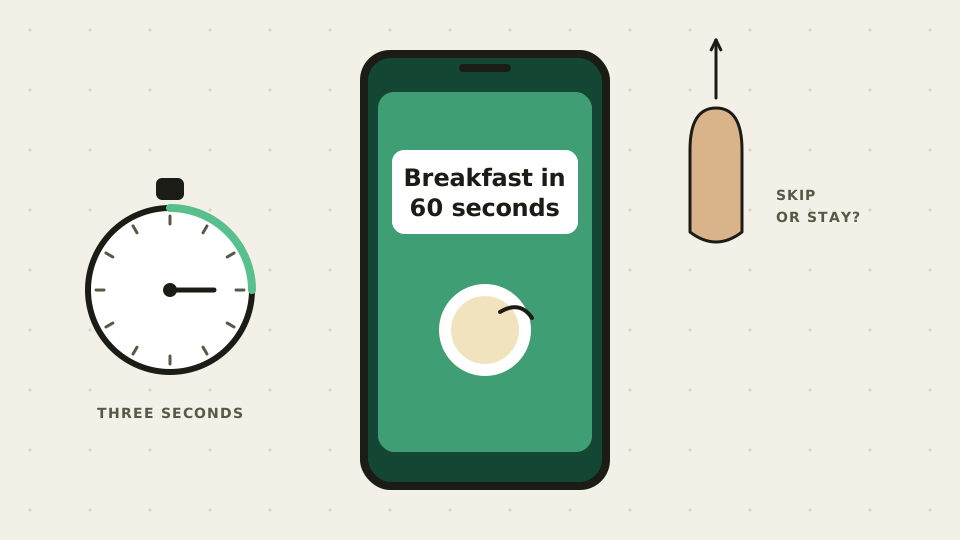
Here is a quick example of how Instagram reel hooks go wrong. Illustration, not a client result: a granola brand opens a reel with a two-second logo animation, then a presenter saying "Hey everyone, so today..." Moving the bowl and the first spoonful to frame one, with the text "Breakfast in 60 seconds," changes what the first 3 seconds say, even if the rest of the reel stays the same.
How do you test Instagram reel hooks before you post?
Test Instagram reel hooks before posting by watching the first 3 seconds on mute, checking the opening against the audit above, filming two or three alternative openings, and running the cut through a free AI read such as Scroll Stopper to catch gaps you are too close to see.
Here is the order that works for testing Instagram reel hooks:
- Mute it. Watch only the first 3 seconds with the sound off. If you would not keep watching, change the picture or the text.
- Run the audit. Go through the table above and fix any "no."
- Film alternatives. Keep the body of the reel the same and change only the opening. One practitioner guide suggests writing three versions of each hook (True Future Media), and the idea is to change one thing at a time so you know what made the difference.
- Get an outside read. Paste the link or upload the video into Scroll Stopper.
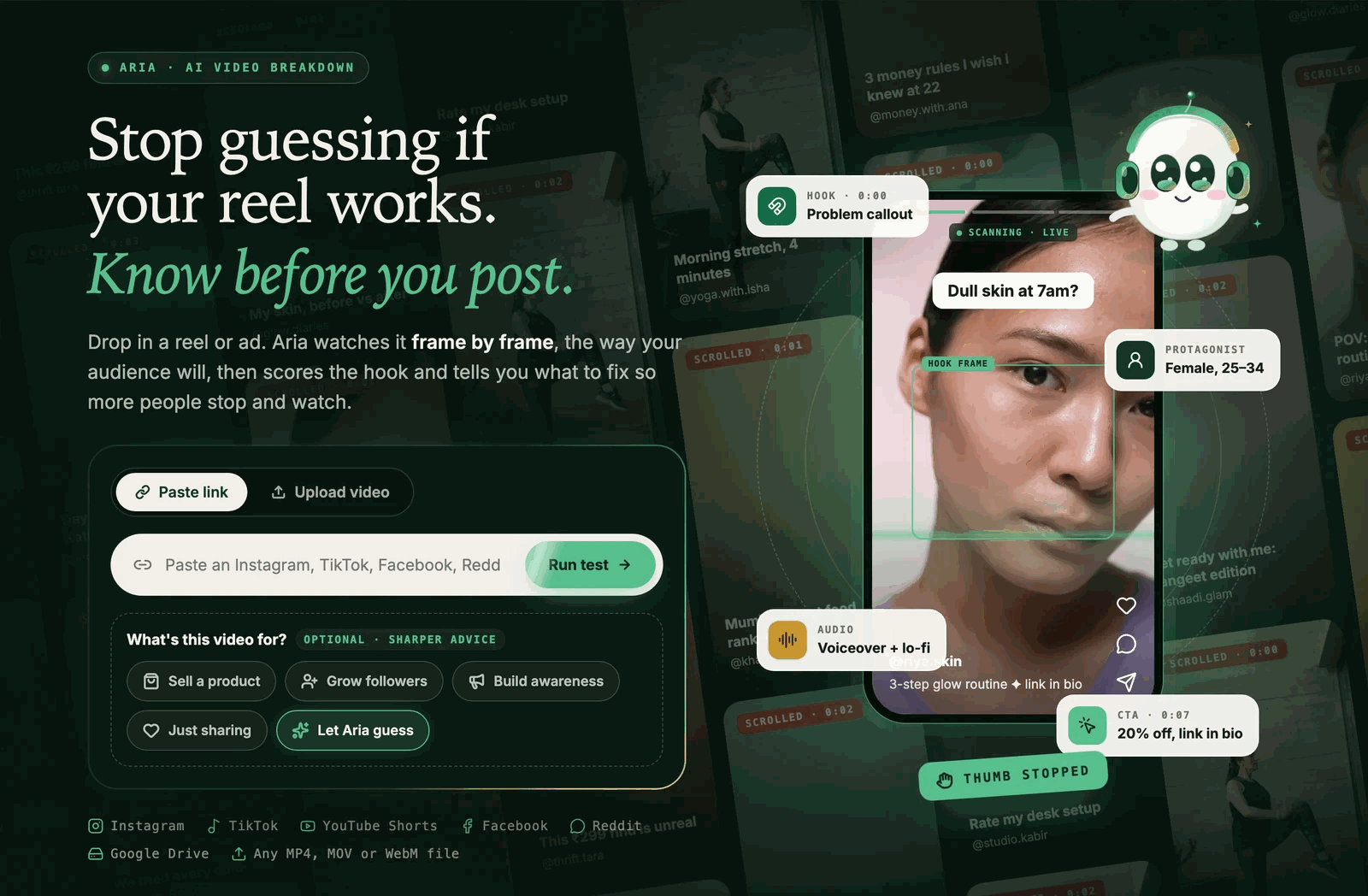
Scroll Stopper is a free tool from Convosight that tells you whether a reel or ad will stop the scroll before you post it. You paste a link or upload an MP4, MOV, or WebM file of up to 3 minutes and 200 MB, and you can pick a goal and a platform for sharper advice. Aria, Convosight's AI, watches the video frame by frame and reads what is said, what is shown, and how it feels. The page says a run usually takes 30 to 90 seconds, with no sign-up.
You get a score out of 100, with separate scores for hook strength, retention, message clarity, and CTA strength. The report also has cards for the hook, the call to action, who is on camera, audio, on-screen text, and products and brands, plus a video anatomy timeline, a scene-by-scene breakdown, a full transcript, and an action plan of edits to make first, such as "show the product in the first two seconds." You can share the report by link.
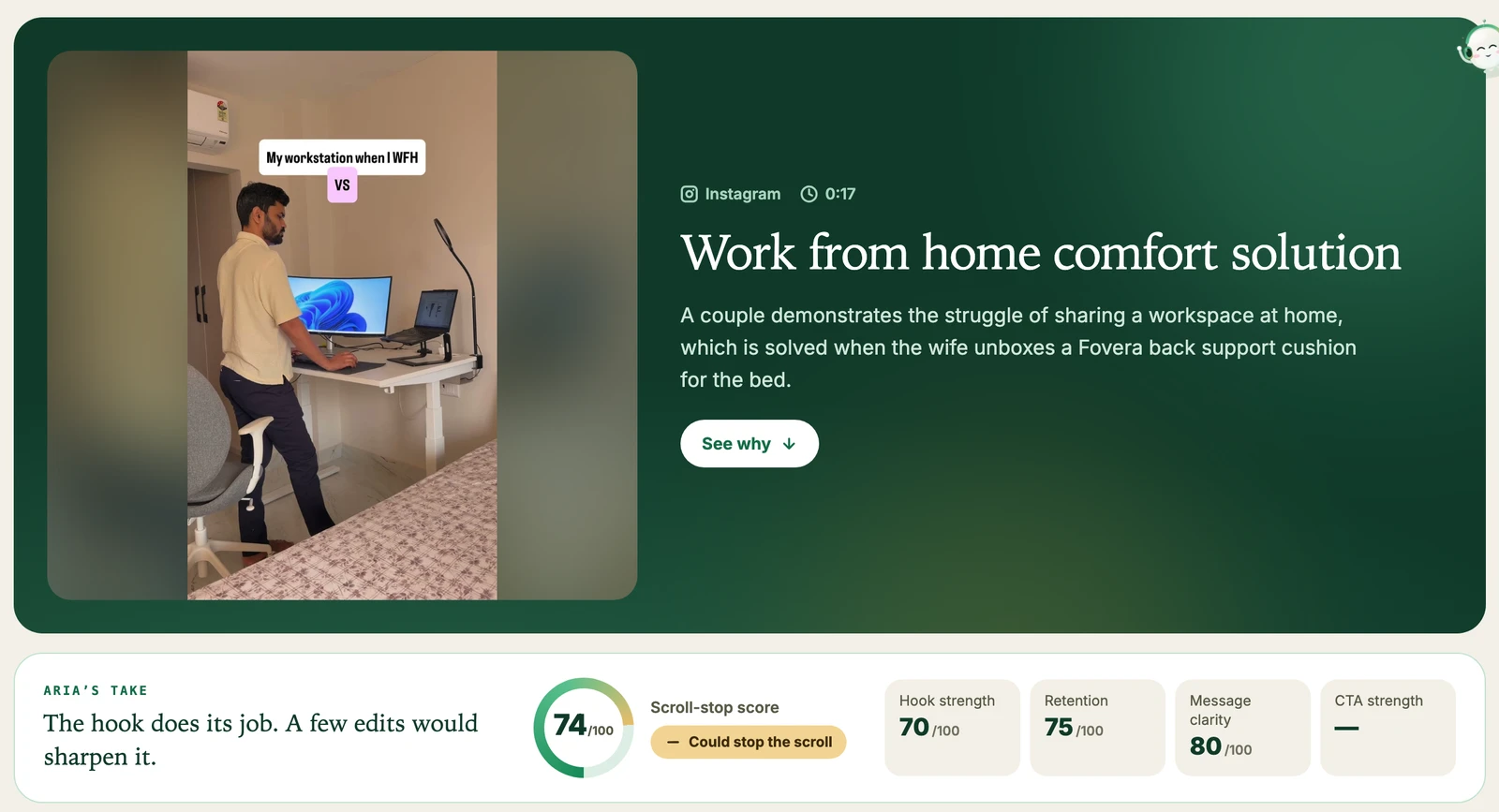
Here is a real shared report for a 17-second Instagram reel about a back support cushion. Aria gave it 74 out of 100 with the label "Could stop the scroll," scoring hook strength at 70, retention at 75, and message clarity at 80. The CTA score is blank because the video has no call to action.
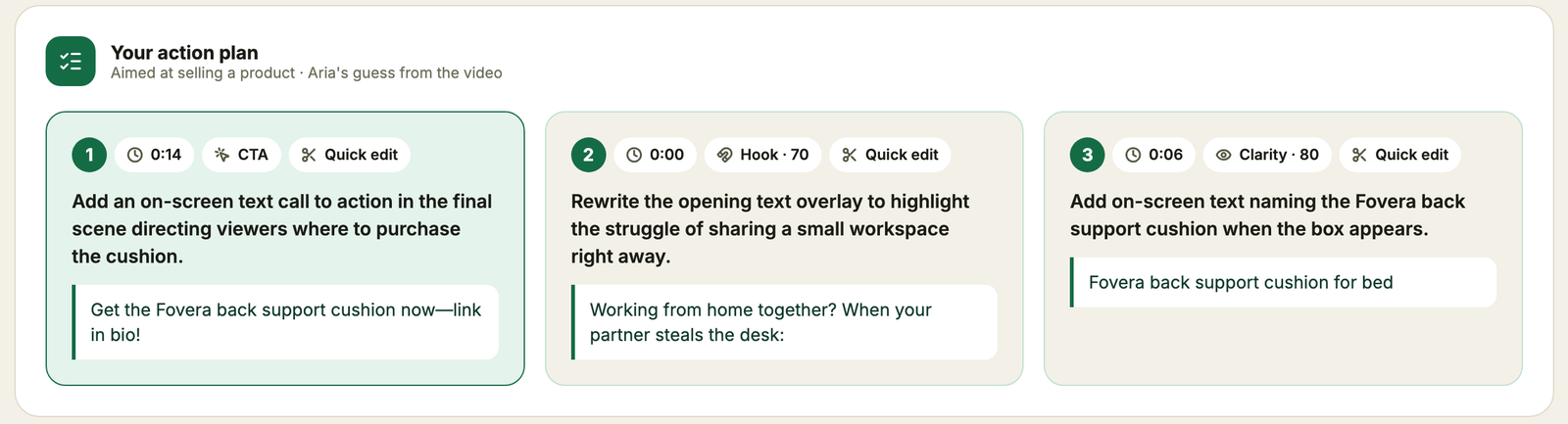
The action plan turns the read into edits. The top item is to add an on-screen text call to action in the final scene. The second is to rewrite the opening text overlay so it spells out the struggle of sharing a small workspace right away, and the third is to name the product in text when the box appears.
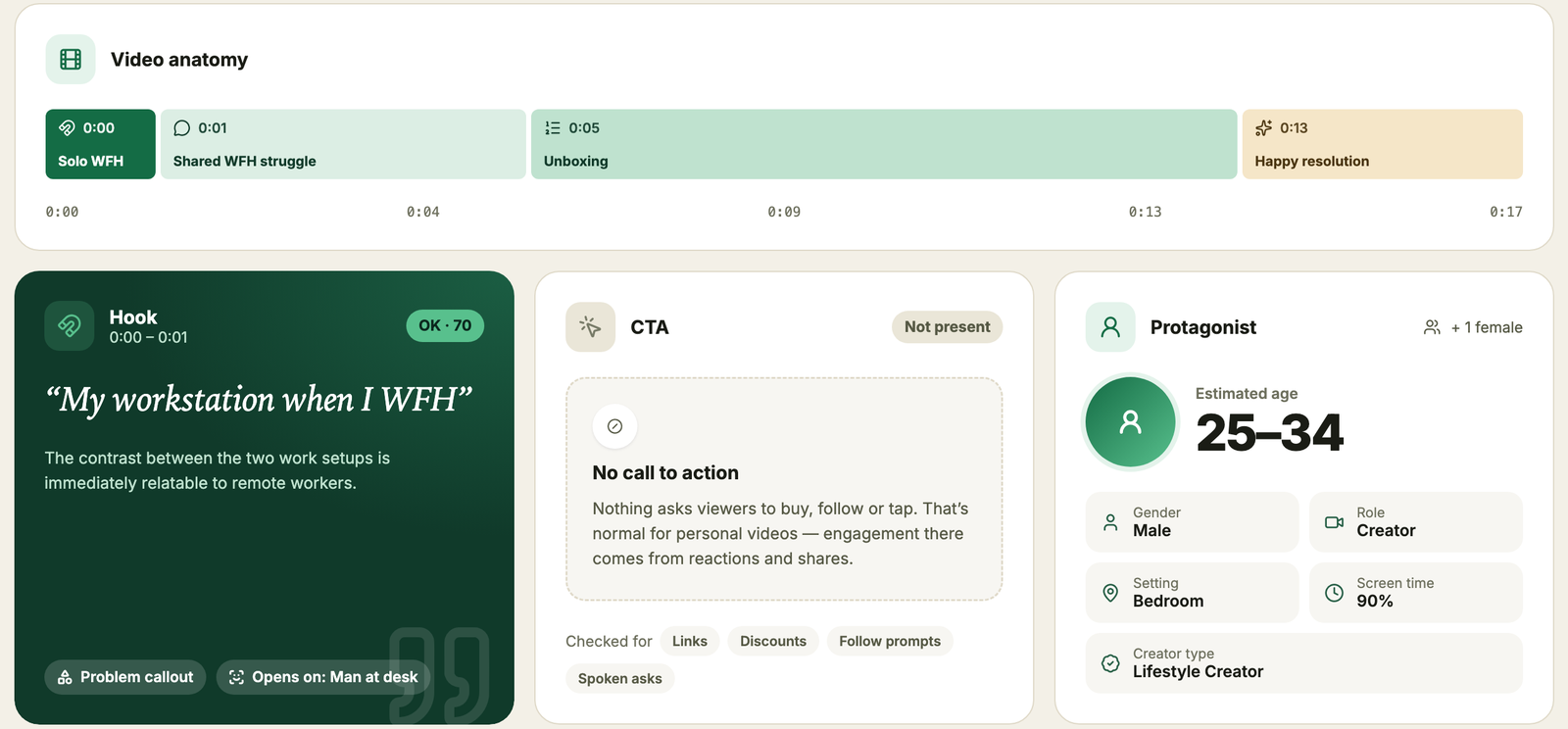
The hook card reads the first second on its own. Here it picked up the text "My workstation when I WFH" over a man at a desk, tagged it a problem callout, and scored it OK at 70. The video anatomy bar splits the 17 seconds into four parts, and the CTA card says plainly that nothing asks viewers to buy, follow, or tap.
The report also lists what works and what does not. In this case, the relatable before-and-after scenario and the clear, sound-off storytelling worked, while the missing call to action and a brand name that shows only on the box did not.
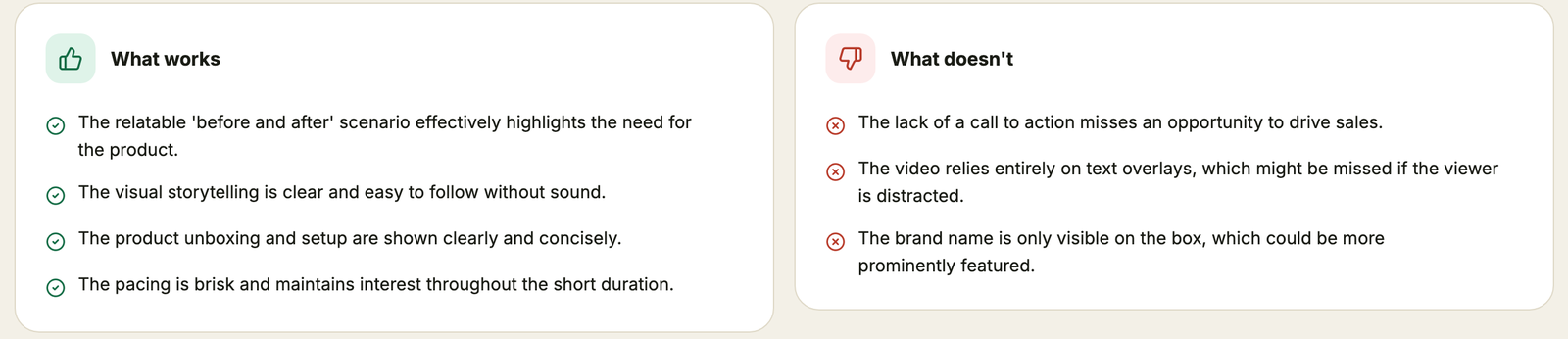
This is one example of what the tool reports, not a measure of how that reel performed.
One limit matters more than the rest: the score is an AI read of the video itself, not a prediction of reach or how the algorithm will treat it. It cannot know whether your audience cares about the topic, and it does not replace testing a real post. Use it to catch craft problems in your Instagram reel hooks early, then let your audience have the final say.
How do you know if your Instagram reel hooks worked?
After posting, read skip rate in your Reel insights and compare it with your own recent reels, because Instagram's announcement gave no benchmark, then check the retention chart to see whether viewers leave inside the first 3 seconds or later in the video.
Compare like with like when you judge Instagram reel hooks. A reel on a new topic, a new format, or a different posting day will move the numbers for reasons that have nothing to do with the hook. Change one thing at a time when you can.
If you run the video as an ad, you will also see hook rate, which counts 3-second video plays as a share of impressions. Motion's glossary gives the formula as (3-second video plays ÷ impressions) × 100 and calls 20 to 40% "generally solid," while noting that rates vary widely by industry and audience (Motion). Treat that as a rough guide. Hook rate and skip rate are different measures, so do not compare one against the other.
How can brands find Instagram reel hooks that fit their category?
Brands can find hooks their category already responds to by watching what the most-viewed videos in the category open with, then recording what each opening shows, says, and writes, instead of copying a generic hook list built for creators in other niches.
Doing that by hand across hundreds of videos is slow. Aria, Convosight's assistant, answers questions about consumers from social video. Per Convosight's site, answers are sorted into what people said, showed, felt, and left unsaid, with the clips and comments behind each one.
The free tools use the same video and social intelligence that powers Aria. Our guides to TikTok social listening and AI video analysis explain how reading video works in practice.
A related example comes from a Convosight case study on influencer content quality control. A skincare brand used frame-by-frame analysis to check influencer videos against 28 quality parameters, including product visibility and when the product first appears. That is quality control, not hook testing, but it shows the same idea at scale: define what a good video shows, then check every video against it.
Be clear about the limits. Aria reads public video, so it shows patterns in what others post. It cannot prove that a given set of Instagram reel hooks will work for your brand. You can find more free tools on the Convosight tools page.
If your team makes short video at scale and wants that read across a whole category, Book a demo. To score a single reel today, try Scroll Stopper first.
FAQ
What are Instagram reel hooks?
Instagram reel hooks are the opening of a reel, made of the first picture, the on-screen text, and the first spoken line. Its job is to give viewers a reason to keep watching. Instagram measures whether it works through skip rate, which counts views lost in the first 3 seconds.
How long should Instagram reel hooks be?
Aim to land the hook inside the first 3 seconds, because that is the window Instagram uses for skip rate. A hook can be one line or one image. What counts is that the viewer understands the subject and the payoff before that window closes.
How do I test Instagram reel hooks before posting?
Watch the first 3 seconds on mute, check the opening against a short audit, and film two or three alternative openings with the same body. Then run the video through an AI read such as Scroll Stopper to catch gaps. After posting, confirm with skip rate and the retention chart.
What is a good skip rate for Instagram reel hooks?
Instagram's announcement of skip rate gave no benchmark, and we found no official threshold. Compare each reel with your own recent reels of a similar length and topic. A lower skip rate than your usual is a better sign than any number from another account.
What is the difference between hook rate and skip rate?
Hook rate is mostly used for video ads and counts 3-second video plays as a share of impressions. Skip rate is Instagram's measure of the percentage of views from people who skipped a reel in its first 3 seconds. They measure different things, so do not compare them directly.
Does the Scroll Stopper score predict how many views my reel will get?
No. The score is an AI read of the video itself, covering hook, pacing, clarity, and the ask. It is not a prediction of reach or of how the algorithm will treat the video. Use it to improve your Instagram reel hooks, then judge results by how real viewers respond.