
Product concept testing shows how shoppers react to a product idea before you spend money building it. Survey-based tests are still the standard for purchase intent and decisions that need a sample size behind them. Claim testing checks the wording of one promise. Social video is a cheaper early signal that complements surveys and does not replace them.
- Product concept testing happens more than once. A rough screen comes early, and a sample-size-backed read comes before the business case is approved.
- Monadic tests give the cleanest score. Sequential monadic tests save budget. Comparative tests answer "which one" and little else.
- Claim testing isolates a single statement. It tells you how a claim lands, not whether it is true.
- Social video can flag a promising idea early and cheaply. It cannot give you a purchase-intent score.
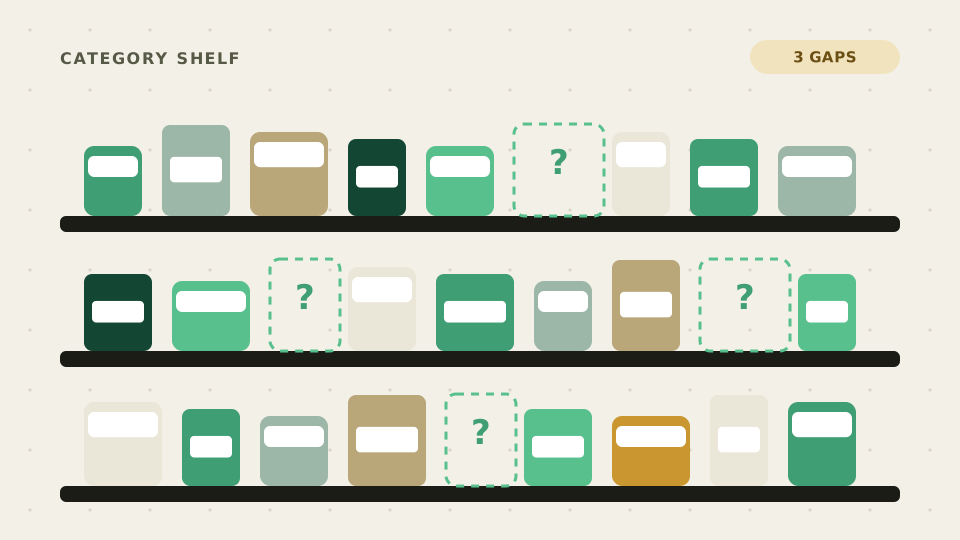
A large share of new CPG products do not last. Product concept testing is how teams find out why before the launch budget is spent. This guide covers where it sits in new product development, the main methods and when to use each, how claim testing differs, and an honest comparison of surveys and social video. Where we cite numbers, each one links to the page it came from.
What is product concept testing?
Product concept testing is a research method that shows consumers a description of a product idea, usually with an image, a price, and the key benefits, and measures their reaction before the product is built or launched, so a team can decide whether to continue, change the idea, or stop.
The risk it addresses is real. A study of 83,719 new SKUs across 31 US CPG categories found that one in four new SKUs is no longer bought one year after launch, and the rate rises to about 40% after two years (Victory and colleagues, Marketing Letters, 2021). A concept test cannot prevent every miss. It can catch the ideas that shoppers do not understand, do not need, or do not believe.
What is a concept? A concept is the idea on paper: a short description, a rough pack image, the main benefit, and sometimes a price. Nobody tastes, smells, or uses anything yet.
That last point separates concept testing from product testing. Product testing puts the physical item in people's hands and asks how it performs. Concept testing judges the idea alone, so a strong concept can still fail once the real product disappoints.
Where does concept testing fit in new product development?
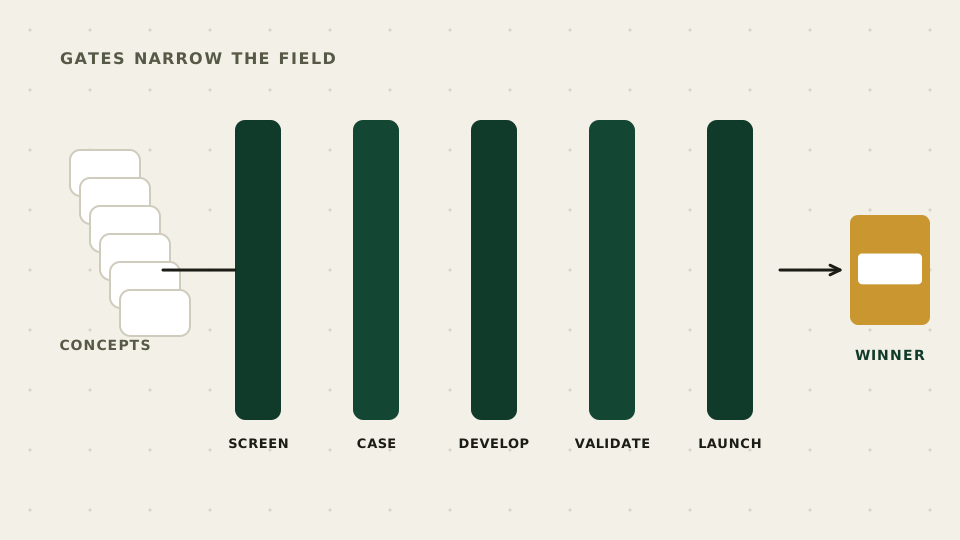
Concept testing in new product development is not one event but a series of checks that grow narrower and more rigorous as a project moves through the stage gates, from a quick screen of rough ideas early on to a final read on pack, price, and claims just before launch.
The stage-gate view is the most common frame in CPG.
Stage-Gate International describes Discovery and Ideation plus five stages: Concept, Build the Business Case, Development, Testing and Validation, and Launch. It also cites an APQC study reporting that 88% of US firms involved in new product development apply the model. Here is how testing usually maps to those stages. The mapping is our editorial view, not part of the model itself.
- Discovery and ideation: No concept exists yet. Teams hunt for unmet needs through white space analysis and consumer listening.
- Stage 1, Concept: A fast, cheap screen. Qualitative interviews and early social video signals cut a long list of ideas down to a short one.
- Stage 2, Build the Business Case: The first sample-size-backed read. A monadic or sequential monadic survey gives purchase-intent scores that feed volume estimates.
- Stage 3, Development: Claim testing, pack tests, and price tests refine the winner. This is also where product testing starts.
- Stage 4, Testing and Validation: A final confirmation of the full mix before launch, often with a larger sample.
The practical rule: spend little where many ideas compete, and spend more where a gate will release real money.
How do companies conduct product concept testing?
Companies conduct product concept testing by writing a clear concept board, recruiting people who buy the category, showing each concept in a controlled order, asking a fixed set of questions, and comparing the scores against a benchmark or rival concepts, and the design choice that matters most is how many concepts each person sees.
Monadic tests
In a monadic test, each respondent sees one concept and answers the full battery. SurveyMonkey's guide says to use it when the decision is high stakes or you need a benchmarkable score. It also advises planning on roughly 200 respondents per cell, with a separate cell for every concept. Use it for the Stage 2 decision.
Sequential monadic tests
Here each respondent sees several concepts one at a time, in randomized order, and answers the same questions after each. The same guide suggests this design for three to six distinct concepts on a fixed budget. The trade-off is order bias, because earlier concepts color how later ones are rated. Randomization spreads the effect but does not remove it.
Comparative tests
Respondents see two or three concepts side by side and pick or rate. This fits one question: which of these two should we pursue? It gives a winner and a weak read on absolute appeal, so a winner can still be a poor idea.
Qualitative tests
Interviews, focus groups, and online discussions explain why people react the way they do. They are small by design and cannot give you a reliable percentage. Use them early to shape the concept, and after a survey to explain a surprising score.
Social-video signal checks
This method reads unprompted TikTok, Instagram, and YouTube video and comments to see whether the need, the language, and the enthusiasm behind a concept already exist. Nobody has been shown your concept board, so it is a proxy for demand and not a test of your execution. Its strengths are speed and cost at the screening stage. For more on reading video this way, see our guide to AI video analysis.
What is claim testing, and how is it different?
Claim testing is a research method that measures how consumers react to one specific statement a brand wants to make about its product, such as a pack callout or a headline, and checks whether people find it believable, relevant, unique, and motivating before it goes on shelf or in an ad.
The difference from concept testing is scope. A concept test judges the whole idea. A claim test isolates one sentence.
SurveyMonkey's claims testing guide says to test product concepts if you want to know whether the entire idea resonates, and to test claims when you are choosing between a short list of statements. It suggests about 100 to 200 respondents per claim in a monadic design.
A claim can score well on one measure and poorly on another. A simple claim may be the most believable while a bolder one drives more intent to buy. Read the measures together.
One limit matters for legal and regulatory teams. A claim test measures perception, not proof.
The FTC's advertising substantiation policy says advertisers must have a reasonable basis for claims before they are disseminated. In the UK, the ASA's guidance on CAP Code rule 3.7 says marketers must hold documentary evidence before publishing an objective claim, and that self-reported consumer data is not enough for claims that need objective backing. A winning claim still needs its evidence file.
What does a concept or claim test look like for a CPG brand?
A typical CPG test pairs a small number of well-defined candidates with a target audience that actually buys the category, then ranks them on a fixed set of measures, and the clearest public example is a prestige skincare serum launch, while a second example shows how an earlier signal read works.
A published claim test. Research firm C+R ran a four-cell monadic claims test for a prestige skincare serum. Each consumer saw one claim, and the team measured appeal, believability, relevance, uniqueness, and purchase interest among current users and prospects. Simpler claims were slightly more believable, but the winner drove the most purchase motivation. Results arrived within five business days. The case study does not publish scores or sample size, so treat it as a design example, not a benchmark.
An early-stage signal read. A Convosight case study on topical pain relief combined social listening, search, reviews, and competitor benchmarking for a North American healthcare company. It drew on 1,380 videos and 19k comments, according to the case study. The output was a roadmap of format, ingredient, and positioning gaps. That is a screening-stage input and not a concept test, and the page does not describe testing the client's own claims.
An illustration, not a client result. Say a snack brand has four claim directions for a high-protein oat bar. Under SurveyMonkey's 200-per-cell guidance, a monadic test needs about 800 completes. A team short on budget might run a social-video check first, drop the two claims nobody talks about, and spend the survey on the remaining two. That cuts the sample need to about 400.
What should a concept test measure?
A concept test should measure purchase intent, appeal, believability, relevance, uniqueness, clarity, and price perception, plus open-ended reasons, all cut by the segments you care about, but the better approach is to pick the decision first and then choose the few measures that actually drive it.
- Purchase intent: Usually reported as top-2-box, the share choosing the top two answers on the scale. It is the headline number, but it is stated intent and not observed buying.
- Appeal and relevance: Does the idea fit a need the shopper actually has?
- Believability: Does the benefit sound true for this product?
- Uniqueness: Does it stand apart from what is already on the shelf?
- Clarity: Can someone explain it back after one read?
- Open-ended reasons: The words shoppers use often become pack copy.
Sample size sets what you can conclude. SurveyMonkey's guidance treats top-2-box differences under roughly nine points as too close to call at 200 per cell. If two concepts land five points apart, a test of that size cannot tell you which is better. Decide the decision rule before fielding, not after the data comes back.
Should you use surveys or social video signals?
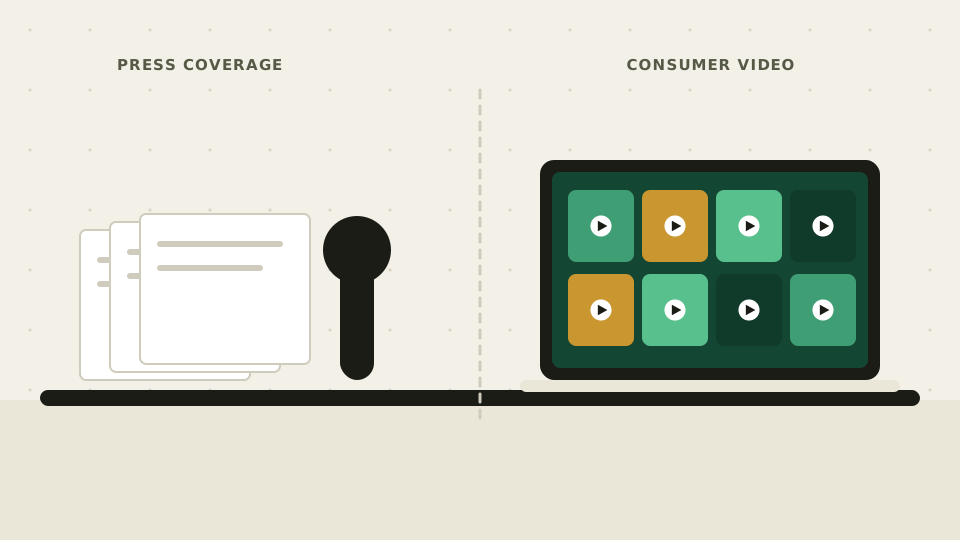
Survey-based tests remain the standard for purchase intent and for any decision that needs a sample size behind it, while social video is an earlier and cheaper signal that suits screening and hypothesis building, so used together the video read narrows the field and the survey makes the final call.
| Survey-based test | Social-video signal check | |
|---|---|---|
| Question answered | Will this concept sell to my target buyer? | Does the need and language already exist? |
| Purchase-intent score | Yes | No |
| Sample-size-backed comparison | Yes, by design | Not in the same sense |
| Speed and cost | Slower, higher | Faster, lower |
| Sees your concept | Yes | No, it reads adjacent behavior |
| Best stage | Business case and validation | Discovery and concept screen |
Social video also has a coverage limit. Pew's 2026 fact sheet finds that 31% of US adults use TikTok, against 84% for YouTube, and TikTok use drops from 65% of adults ages 18 to 29 to 11% of those 65 and older. If your buyer skews older, video signals will under-represent that buyer. Check who you are hearing from before you act on it.
The honest summary is that nobody should approve a launch on social video alone. Equally, a team that runs only surveys can miss what shoppers are already saying unprompted. The two methods answer different questions.
What mistakes sink concept tests?
The most common mistakes are testing a polished ad instead of the idea, showing too many concepts to each respondent, recruiting people who never buy the category, and fielding a study without a decision rule, and each one produces a number that looks precise but quietly misleads the team.
- Testing finished creative. A great ad can rescue a weak idea in a test and mask the problem.
- Overloading respondents. Fatigue and order bias grow with every extra concept. SurveyMonkey advises keeping concepts times metrics under 30 questions in a sequential design.
- Wrong sample. Category users and non-users react differently, so screen on purchase behavior.
- Underpowered cells. Small cells make small differences look like winners.
- Treating a claim test as substantiation. Perception data does not replace evidence.
- Testing once. A single read at Stage 1 says nothing about the final pack, price, and claim mix.
How does Convosight support concept and claim testing?
Convosight reads TikTok, Instagram, and YouTube video with comments for enterprise CPG insights and brand marketing teams in the US and UK, and its homepage describes Persona as helping teams pressure-test claims, concepts, and strategy before the next product launch or campaign, with concept and claim testing among the use cases for insights and R&D teams.
In the stage-gate view above, that sits at the front: discovery, early screening, and shaping the claims you carry into a survey. It pairs with the survey work described earlier and does not replace it. For the wider practice, see our guide to consumer insights. Convosight is trusted by Unilever, Abbott, Kenvue, Pepsi, SC Johnson, and Kimberly-Clark.
Want to see how this works on your own category? Book a demo.
FAQ
What is product concept testing?
Product concept testing is a research method that shows consumers a description of a product idea, often with an image and price, and measures their reaction before the product is built. Teams use the results to decide whether to continue, revise, or stop a project.
How do companies conduct product concept testing?
Companies write a concept board, recruit buyers of the category, and show the concept in a set order. They ask the same questions on purchase intent, appeal, believability, and uniqueness, then compare scores against a benchmark or rival concepts. Monadic, sequential monadic, comparative, and qualitative designs are the common choices.
What is concept testing in new product development?
In new product development, concept testing is a series of checks across the stage gates. Early on it is a quick, low-cost screen of many ideas. Later it is a sample-size-backed survey that feeds the business case, followed by a final read on pack, price, and claims before launch.
What is claim testing?
Claim testing measures how consumers react to one statement a brand wants to make about its product. Researchers check whether people find it believable, relevant, unique, and motivating. It tells you how wording lands. It does not replace the evidence regulators expect you to hold for the claim.
How many people do you need for a concept test?
One published guide recommends about 200 respondents per cell, and notes that at that size top-2-box differences under roughly nine points are too close to call. Monadic tests need a separate cell for each concept, so four concepts need about 800 completes. Qualitative work uses far fewer people.
What is the difference between concept testing and product testing?
Concept testing judges the idea on paper, using a description, image, and price, before the product exists. Product testing puts the physical item in people's hands and asks how it tastes, smells, or performs. A concept can test well and still fail if the real product disappoints.